





Soft Landings for fit-outs
Contents |
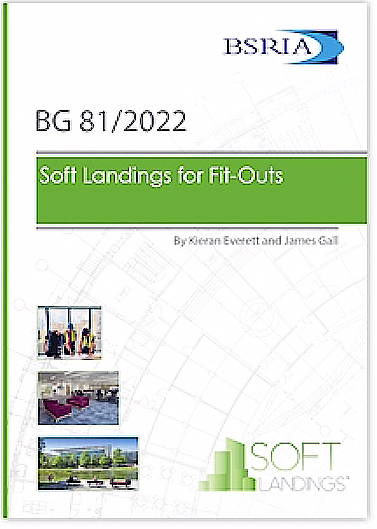
[edit] BSRIA publishes Soft Landings for Fit-Outs (BG 81/2022)
In 2022, BSRIA announced publication of Soft Landings for Fit-Outs (BG 81/2022).
The new guide is intended for use by all parties of a fit-out project, from the client to the consultant team. It establishes the methodologies which can be adopted by the project team to promote better understanding, engagement, and contribution by all.
Soft Landings for Fit-Outs is the latest in a line of guidance publications by BSRIA on Soft Landings – the UK construction industry’s premier project improvement process. Interest in Soft Landings has been driven by increasing recognition of the vital role it now plays in the delivery of sustainable buildings; helping ensure that sustainability targets are set at the very beginning of the project, reviewed throughout, and achieved upon completion.
The new guide is available now from the BSRIA Bookshop, with free downloads available to BSRIA Members.
[edit] What is Soft Landings?
Soft Landings is a building delivery process which runs through the project, from inception to completion and beyond. It ensures all decisions made during the project are based on optimising operational performance of the building and meeting the client’s expectations.
The basis of Soft Landings is a set of principles that define a mindset for client-focused project delivery. Considered together with a supporting framework of activities arranged in six phases running from inception and briefing to post completion extended aftercare, Soft Landings runs in parallel and is complimentary to the RIBA Plan of Work.
Soft Landings can be adopted for all projects irrespective of their type and size. The level of involvement, in terms of time and effort, by the supply chain post-completion should be proportional to the nature of the project.
[edit] Soft Landings for Fit-Outs
Fit-out contracts, by their very nature, do not involve construction of new buildings. In such instances, it is therefore common for Soft Landings, as an entire process, to be overlooked. This is often due to financial or time constraints or even a misunderstanding amongst the project team that it has little relevance.
It is therefore possible that, at the point of appointing a fit-out main contractor, the benefits of adopting the Soft Landings framework have not been highlighted to the client and as such the early stages may not have been followed.
Soft Landings for Fit-Outs (BG 81/2022) addresses this by establishing methodologies which can be adopted by the project team to promote better understanding, engagement, and contribution by all.
--BSRIA
[edit] Related articles on Designing Buildings
- 2021 Soft Landings Conference.
- Better Buildings Partnership.
- BSRIA guidance on project information process BG 78/2021.
- BSRIA Soft Landings Awards.
- BSRIA updates Handover and O&M manuals.
- Building log book.
- Building owner's manual.
- Building users guide.
- Building performance evaluation.
- Building performance evaluation in non-domestic buildings guide – an introduction to the tests and methods in non-domestic buildings
- Client commissioning.
- Defects liability period.
- Extended aftercare.
- Fabric first investigation into net zero for existing buildings.
- Handover to client.
- Initial aftercare.
- Lessons learned report.
- Medical Research Council Laboratory of Molecular Biology soft landings project.
- Migration strategy.
- PAS 2038:2021 Retrofitting non-domestic buildings for improved energy efficiency.
- Post occupancy evaluation.
- Post project review.
- Performance in use.
- Performance of exemplar buildings in use: Bridging the performance gap FB 78.
- Snagging.
- Soft landings
- Soft landings - helping clients lead contractors.
- Soft landings and business-focused maintenance.
- Soft Landings and Government Soft Landings - A convergence guide for construction projects.
- Soft Landings for owners.
- Specialist commissioning manager.
- Success criteria for soft landings projects.
- Taking action on climate change.
- Technical guide.
Featured articles
Check out some of the best features and news from Designing Buildings as well as key stories from around the web.

Government approach could undermine delivery and regeneration.
World's first mass timber data centre.

The overlooked environmental aspect of data centre development.
Introduction to radon awareness

New technical information sheet published by CIOB.

Updated supplier guide can help electrical contractors engage with NHP.

CIAT confirm the winners of the 2026 architectural technology awards.

Government launches a one stop shop for flood preparedness.

Sir Edwin Lutyens: Britain's greatest architect? Book review.

CIOB publishes free template to help assess and manage risks.
ECA's reflections on Party Conference season

Burnham wants to be confident of winning before asking for a fresh mandate.
New Chief Construction and Scientific Adviser

Sergio Cavalaro, Professor of Infrastructure Systems at Loughborough University.
Building safety levy for England

CIAT publish estimator tool for members.

Water sector faces a growing crisis that could slow the delivery of vital infrastructure.